Sunday, March 31, 2024

Farnsworth House Description, History, & Facts

farnsworth house

Discover Mies van der Rohe’s modernist masterpiece with our Farnsworth House and Farnsworth House PLUS tours. The design of the house was so acclaimed that a 1947 exhibition of Mies’ work at the Museum of Modern Art included a model of the Farnsworth House before it was even built. Since then, the house has been included in the National Register of Historic Places (2004) and designated a National Historic Landmark (2006).

Materials

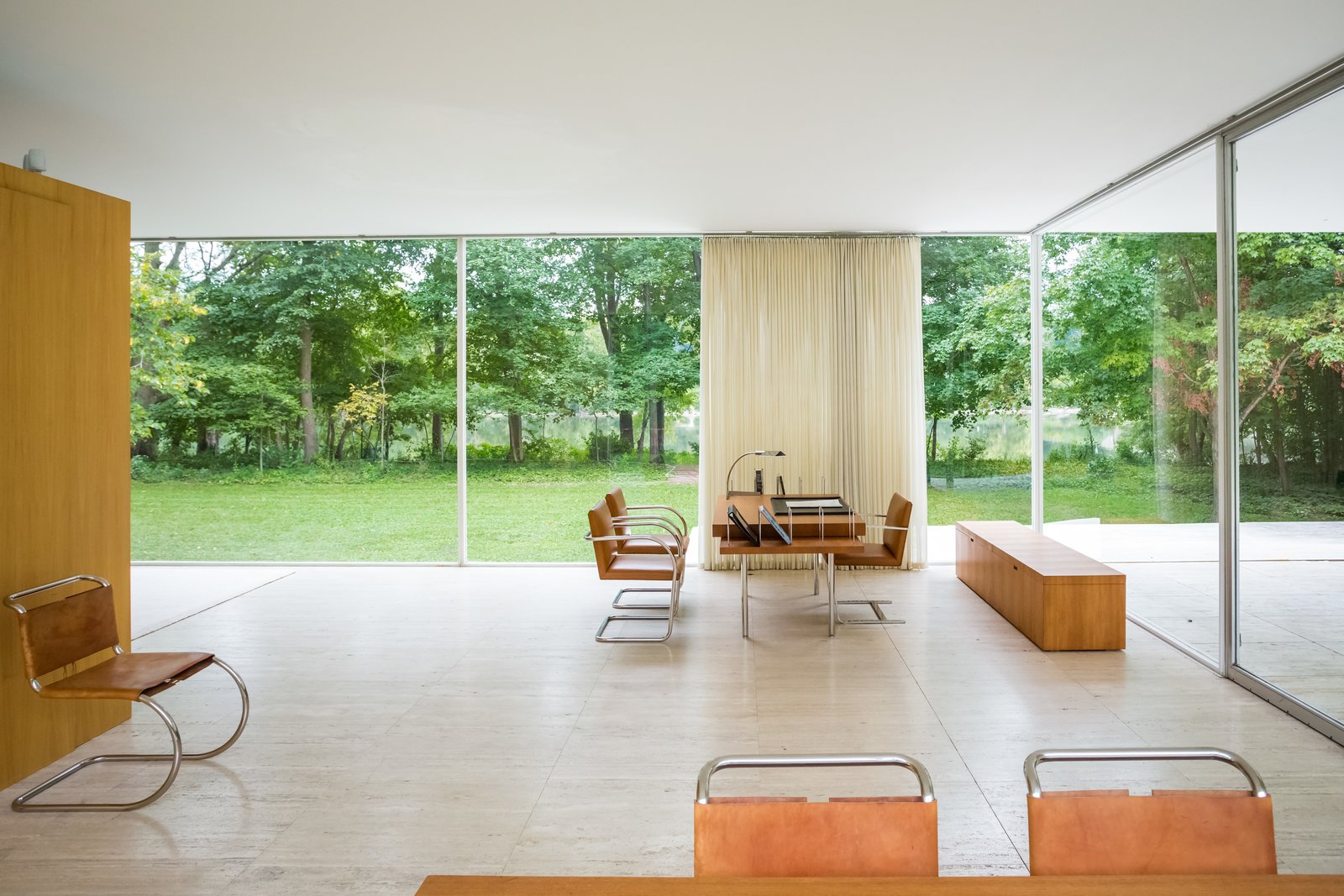
The house remains between the trees as if on tiptoe, without disturbing the grass’ growth, nor the regularity and volume of the river when it overflows. The manifest will to preserve the natural order of the place in every way and for the house to experience nature unaltered is plain to see. The house consists of a metal structure enclosed only by glass which creates the impression of a viewpoint, and pays tribute to the beauty of the space surrounding the house.

Related Tour

farnsworth house

But he believed the individual can and should live in harmony with the culture of one’s time for successful fulfillment. With the Farnsworth house constructed about 100 feet from the Fox River, Mies recognized the dangers of flooding. He designed the house at an elevation that he bellieved would protect it from the highest predicted floods, which are anticipated every hundred years. The Farnsworth House, built between 1945 and 1951 for Dr. Edith Farnsworth as a weekend retreat, is a platonic perfection of order gently placed in spontaneous nature in Plano, Illinois. Mies created a 1,500-square-foot (140 m2) structure that is widely recognized as an exemplar of International Style of architecture.

The Edith Farnsworth House

In 1972, Dr. Edith Farnsworth sold Farnsworth House to Baron Peter Palumbo, a British arts patron who had restored several other historic properties. When Palumbo listed the building for sale at Sotheby’s auction house in 2003, several potential buyers inquired about dismantling the structure and moving it to another state. The Edith Farnsworth House is located approximately 58 miles southwest of Chicago in Plano, Illinois along the Fox River.

Types of Art – Learning About the Different Forms of Art

'Tremendous collection' of midcentury architecture focus of tour in Flossmoor, Olympia Fields - Chicago Tribune

'Tremendous collection' of midcentury architecture focus of tour in Flossmoor, Olympia Fields.

Posted: Mon, 19 Jun 2023 07:00:00 GMT [source]

His idea for shading and privacy was through the many trees that were located on the private site. The Farnsworth House sits isolated on a floodplain that faces the Fox River, establishing the architect's concept of simple living. Open views from all sides of the building help enlarge the living space area and aid flow between the living space and its natural surroundings.

The Farnsworth House did not refer to a historical period and did not attempt to create an enclosure. Wrapping the house in glass reduces the feeling of enclosure and dissolves the boundary between inside and outside. It has a flat roof keeping the silhouette of the building to a simple rectangle absent of any angels or ornamentation. The Farnsworth house is important because it challenged the idea of a conventional home. Simply put, it was so starkly different from homes that people were familiar with at that time.

Relationship with the body of water

In this way the horizontal planes are maintained, fundamentally separated from the original terrain. Mies determined the proportions and form of the box while barely pre-calculating the dimensions of the needs of the project. This is demonstrated by the fact that even the most imprecise draft of the services core clearly incorporates the perimeter of the floor and the location of the pillars. In this way, once the structure had been resolved, they studied the interior elements which had to fit into the project.

Who Designed the Furniture in the Farnsworth House?

It’s one of the most significant of Mies van der Rohe’s works and among the world’s great architectural masterpieces. A founder and leader of the modernist movement in Europe, Mies lived and worked in Chicago for more than 30 years. He is well known for his use of glass and steel, as well as his sleek design aesthetic and the “less is more” philosophy that influenced city skylines around the world. Farnsworth House, the temple of domestic modernism designed by Mies van der Rohe as a weekend retreat for a Chicago doctor, is one of the most paradoxical houses of the 20th century. A perfectionist mirage, it floats like a pavilion in a park, but its history has been beset by plagues, floods and feuds. As the second installment of a series of three modernist classics presented by Archilogic, we’ve modeled the Farnsworth house so that you can see if—in spite of its austere reputation—it can be lived in after all.

How Many Times Has the Farnsworth House Flooded?

Mies accepted the problems of industrial society as facts to be dealt with and offered his idealized vision of how technology may be made beautiful and support the individual. He suggests that the downsides of technology decried by late-nineteenth-century critics such as John Ruskin can be solved with human creativity and shows us how in the architecture of this house. The Farnsworth House addresses fundamental issues about the relationship between the individual and his society. Mies viewed the technology-driven modern era in which an ordinary individual exists as primarily beyond one’s control.

He did not believe in the use of architecture for social engineering of human behavior, as many other modernists did, but his architecture does represent ideals and aspirations. His mature design work is a physical expression of his understanding of the modern epoch. He provides the occupants of his buildings with flexible and unobstructed space in which to fulfill themselves as individuals, despite their anonymous condition in the modern industrial culture. Mies accepted the problems of industrial society as facts to be dealt with, and offered his idealized vision of how technology may be made beautiful and support the individual as well.

Farnsworth House installation replicates original decor of Edith Farnsworth - Dezeen

Farnsworth House installation replicates original decor of Edith Farnsworth.

Posted: Wed, 22 Jul 2020 07:00:00 GMT [source]

However, seeing the building in person, experiencing the spaces, and closely observing the details gave me a new appreciation for this seminal work of architecture. Mies was also deeply aware of how industrial life cut off human beings from nature. He once said, “We should attempt to bring nature, houses, and the human being to a higher unity.” He certainly achieved that with the Edith Farnsworth House. The above photo of the exterior shows the trees surrounding the home reflecting in the glass. When the court case brought the house to broad public attention, critics of the International Style suggested a communist agenda by Mies and other modern architects. Edith Farnsworth commissioned Ludwig Mies van der Rohe to design and build the home on a flood plain in Plano, Illinois.

Arguably, she was the first to preserve a portion of the McCormick land holdings as a nature retreat, purchasing additional land in 1962, followed by the acquisition of the remaining McCormick lands by the State of Illinois during the late 1960s. Since the early nineteenth century land survey imposed boundaries that did not previously exist, National Trust staff continue to study our site history in larger physical and social contexts. The ground floor of the Farnsworth House is thereby elevated, and wide steps slowly transcend almost effortlessly off the ground, as if they were floating up to the entrance. Aside from walls in the center of the house enclosing bathrooms, the floor plan is completely open exploiting true minimalism. We specialize in custom luxury home builds that mirror each client's unique style.

It is a less-is-more structure, and it stands as a subtly simple construction that served well as a location far from the hubbub of the industrialized world. He ultimately decided that it would be best to integrate the individual within this new modern age through the use of orderly designs. When it comes to the Farnsworth House, Ludwig Mies van der Rohe sought a means to produce the kind of residential structure that could coincide with the principles that he espoused in his work.

Mies wanted to use architecture as a tool to help reconcile the individual spirit with the new mass society in which the individual exists. Farnsworth had purchased the wooded, nine-acre riverfront property from the publisher of the Chicago Tribune, Robert R. McCormick. The commission was an ideal one for any architect, but was marred by a very publicized dispute between Farnsworth and Mies that began near the end of construction. A cost overrun of $15,600 over the initially approved construction budget of $58,400, was due to escalating material prices resulting from inflationary commodities speculation (in anticipation of demand arising from the mobilization for the Korean War). Near the completion of construction, the architect filed a lawsuit for non-payment of $28,173 in construction costs.

His work started in Germany, but he was forced to flee due to the Nazi Party, and he eventually moved to the United States to become both a teacher and a prolific architect. He would do this by aiming towards a form of simplicity in the structures that he designed. He would often label the buildings that he designed as a form of “skin and bones” architecture. This allows the Farnsworth House’s interior to remain open, and the use of a glass façade means that natural light easily flows into the structure. To add to that light, the white walls allow it to be further reflected and thereby add to the illumination of the building as a whole.

Saturday, March 30, 2024

This 3 bedroom 2 1 2 bath brick house apts housing for rent apartment rent craigslist

2 bedroom house for rent

Excluding London, the local area with the highest average private rent in March 2024 was the City of Bristol, South West (£1,748). The average private rent in Great Britain was £1,246 in March 2024, which is £104 (9.1%) higher than 12 months ago. UK monthly rent estimates for the latest two months and UK HPI estimates for the latest 12 months are provisional and subject to revision.

Some Greater Victoria two-bedroom rents now more than renting entire houses - Victoria News

Some Greater Victoria two-bedroom rents now more than renting entire houses.

Posted: Mon, 16 Oct 2023 07:00:00 GMT [source]

Private rent and house price data

Scotland rents data are predominantly for advertised new lets, with only a small proportion based on existing lets data. Therefore, price changes for existing tenancies are largely estimated for Scotland. Annually, over 450,000 private rent prices are collected in England and around 30,000 in Wales, 40,000 in Scotland, and 15,000 in Northern Ireland. Interchangeable with "annual inflation" (or "annual growth", if positive).

Figure 4: Average rent annual inflation was highest in London

The Cost of Living (Tenant Protection) Scotland Act capped in-tenancy rent price increases at 0% (and up to 3% in certain circumstances) from September 2022 until 31 March 2023. Between 1 April 2023 and 31 March 2024, this rent price-increase cap was 3% (and up to 6% in certain circumstances). From 1 April 2024, temporary changes to the rent adjudication system restricts rent increases for existing tenants who apply for rent adjudication. More detail is available in our Quality assurance of administrative data used in the PIPR methodology.

2 bedroom house for rent

Price Index of Private Rents

In March and April 2024, UK HPI estimates were revised from January 2021 onwards by making use of price data processed outside the UK HPI's normal 12-month revision period. Users should be aware that revisions may be larger than usual and should note the significantly greater uncertainty around new build prices. UK HPI will now return to the usual 12-month revision period for future releases. Average private rent for Wales was £727 in March 2024, up 9.0% (£60) from a year earlier. This annual rise was unchanged from the 12 months to February 2024, but remains below Wales's record-high annual rise of 9.8% in November 2023, which was the highest annual rise since this series began in 2010. These caps and restrictions will not be reflected in the price of new lets used to estimate the price of existing tenancies.

Wales

There was a varied distribution in average monthly private rents across local authorities in England and Wales, and Broad Rental Market Areas in Scotland. Average UK house prices decreased 0.2% (provisional estimate) in the 12 months to February 2024, to £281,000. This was up from a decrease of 1.3% in the 12 months to January 2024 (revised estimate). Each subsequent month, updated Northern Ireland data are used to revise estimates for the UK. This means that there is a two-month revision period for the UK series in PIPR.

Private rent and house prices, UK: April 2024

Median Gold Coast rental prices soar to $850 a week for a house, $680 a week for a unit - ABC News

Median Gold Coast rental prices soar to $850 a week for a house, $680 a week for a unit.

Posted: Sun, 14 Jan 2024 08:00:00 GMT [source]

More information is available in our PIPR Quality and Methodology Information (QMI). Inflation is the rate at which prices (for renting or purchasing property) rise and fall over time. In their March 2024 UK Residential Market Survey, the Royal Institution of Chartered Surveyors (RICS) reported rising tenant demand and, for the 20th consecutive month, declining volume of new landlord instructions. Because of this imbalance, their respondents continue to expect rents to rise over the coming months. In recent periods, the total transaction volumes and new build volumes available to calculate UK HPI estimates for recent months have been lower than historically. The Office for National Statistics (ONS) and HM Land Registry (HMLR) are working to resolve this.

Figure 1: UK rents inflation is rising to record-highs, while UK house price annual inflation remains negative

2 bedroom house for rent

Price Index of Private Rents QAAD Methodology | Released 20 March 2024 Quality assurance of administrative data (QAAD) used in the monthly production of Price Index of Private Rents (PIPR). We are investigating the feasibility of extending the time-series back further. The full UK House Price Index report and monthly data are published by HM Land Registry. Estimates for the City of London and Isles of Scilly are not published because of low collection volumes.

Measuring the data

Average UK private rent increased by 9.2% in the 12 months to March 2024 (provisional estimate). This was up from 9.0% in the 12 months to February 2024 (revised estimate) and represents the highest annual percentage change since this UK data series began in January 2015. Average private rent in Northern Ireland increased by 10.1% in the 12 months to January 2024, up from 9.3% in December 2023. Our new local housing statistics tool summarises the latest private rents and house price statistics for local areas. To produce provisional UK statistics, Great Britain's inflation rate for the latest two months has been used to estimate Northern Ireland's inflation rate in this period. Since the Price Index of Private Rents (PIPR) measures rent price changes of the entire privately-rented stock, changes in new-let annual inflation from supply and demand pressures take time to be reflected in PIPR.

Figure 3: The average rent annual inflation for England rises above the rate for Wales

Average private rent for England was £1,285 in March 2024, up 9.1% (£107) from a year earlier. This is the highest annual rise since this series began in 2006 and was up from 8.8% in February 2024. PIPR replaced the Index of Private Housing Rental Prices (IPHRP) and Private Rental Market Summary Statistics (PRMS) in March 2024. PIPR produces rent prices that are comparable over time (unlike PRMS) and publishes at increased geographic granularity than IPHRP. The Price Index of Private Rents (PIPR) reflects price changes for all privately-rented properties (including for existing tenancies), not only changes for newly-advertised lets.

We aim to include Northern Ireland in the Price Index of Private Rents (PIPR) in March 2025. In the 12 months to February 2024, average house prices decreased in England to £298,000 (negative 1.1%), decreased in Wales to £211,000 (negative 1.2%) and increased in Scotland to £188,000 (5.6%). Average house prices increased by 1.4% to £178,000 in the year to Quarter 4 (Oct to Dec) 2023 in Northern Ireland.

All statistics are non-seasonally adjusted estimates, unless explicitly stated otherwise. While mitigation efforts are made, price changes at local levels can be influenced by the type and number of properties collected in any given period, which may lead to volatility. Longer-term trends should be considered for lower-level geographic breakdowns, rather than monthly movements. For Great Britain in March 2024, the average private rent was highest for detached properties (£1,446) and lowest for flats and maisonettes (£1,211).

The rise in Scotland’s annual inflation rate in recent months is more reflective of Scotland’s average house price falling this time last year, rather than increasing in recent months. This is known as a base effect, as explained in our Beware base effects blog. Scotland's average house price fell in winter 2022 to 2023, reaching a low point in February 2023. Scotland's average house price returned to mid-2022 price levels by mid-2023 and has since remained comparatively stable. This new release uses the Price Index of Private Rents (PIPR) to provide more insight into the UK private rental sector and includes headline UK HPI statistics. Average private rent for Scotland was £947 in March 2024, up 10.5% (£90) from a year earlier.

Average private rent was highest for properties with four or more bedrooms (£1,912) and lowest for properties with one bedroom (£995). In March 2024, the average monthly private rent was highest in London (£2,055) and lowest in the North East (£662). Annual rents inflation was lowest in the North East, at 6.1% in March 2024. This was up from 5.7% in February 2024, and represents the joint-highest annual percentage change since this series began in January 2006. Because of differences in data collection and housing policy, caution is advised when comparing Scotland's estimates with other areas in England and Wales and within Scotland.

By chain-linking the IPHRP (pre-2015) and PIPR (2015 onward) indices together, we have published a full historical series for the UK, Great Britain, its countries and English regions. Series begin in January 2005 for England, January 2009 for Wales, January 2011 for Scotland, and January 2015 for Northern Ireland and the UK. We advise caution when comparing pre-2015 trends with later estimates because of the methodology change in January 2015. In March 2024, the average private rent was highest in Kensington and Chelsea, London (£3,305), and lowest in Dumfries and Galloway, Scotland (£475).

Scotland's annual inflation rate has been generally slowing since the record-high annual rise of 11.8% in August 2023, which was the highest annual rise since this series began in 2012. The Price Index of Private Rents (PIPR) is released as official statistics in development, and is subject to revisions if improvements in the methodology are identified. Currently, average private rent is published for Great Britain, but not for the UK. We aim to publish average rent prices for the UK and Northern Ireland in March 2025. Housing prices in your area Interactive tool | Released 17 April 2024 Find house prices and private rental prices for local authority areas across Great Britain.

Price Index of Private Rents (PIPR) measures private rent inflation for new and existing tenancies. This means that a large proportion of data for Brent are from recent months. Since UK rents have been rising at a record-high pace for more than a year, this has led to a sharp increase in the estimated rent price for Brent recently. In England and Wales, achieved rents data are collected for both new and existing tenancies. Rent Officers receive a notification 12 months after a property's last update, supporting their aims to revisit properties.

Private rent and house prices, UK Office for National Statistics

2 bedroom house for rent

Scotland's annual inflation rate has been generally slowing since the record-high annual rise of 11.8% in August 2023, which was the highest annual rise since this series began in 2012. The Price Index of Private Rents (PIPR) is released as official statistics in development, and is subject to revisions if improvements in the methodology are identified. Currently, average private rent is published for Great Britain, but not for the UK. We aim to publish average rent prices for the UK and Northern Ireland in March 2025. Housing prices in your area Interactive tool | Released 17 April 2024 Find house prices and private rental prices for local authority areas across Great Britain.

Price Index of Private Rents

2 bedroom house for rent

Scotland rents data are predominantly for advertised new lets, with only a small proportion based on existing lets data. Therefore, price changes for existing tenancies are largely estimated for Scotland. Annually, over 450,000 private rent prices are collected in England and around 30,000 in Wales, 40,000 in Scotland, and 15,000 in Northern Ireland. Interchangeable with "annual inflation" (or "annual growth", if positive).

Private rent and house price data

Excluding London, the local area with the highest average private rent in March 2024 was the City of Bristol, South West (£1,748). The average private rent in Great Britain was £1,246 in March 2024, which is £104 (9.1%) higher than 12 months ago. UK monthly rent estimates for the latest two months and UK HPI estimates for the latest 12 months are provisional and subject to revision.

Annual percentage change

All statistics are non-seasonally adjusted estimates, unless explicitly stated otherwise. While mitigation efforts are made, price changes at local levels can be influenced by the type and number of properties collected in any given period, which may lead to volatility. Longer-term trends should be considered for lower-level geographic breakdowns, rather than monthly movements. For Great Britain in March 2024, the average private rent was highest for detached properties (£1,446) and lowest for flats and maisonettes (£1,211).

The Cost of Living (Tenant Protection) Scotland Act capped in-tenancy rent price increases at 0% (and up to 3% in certain circumstances) from September 2022 until 31 March 2023. Between 1 April 2023 and 31 March 2024, this rent price-increase cap was 3% (and up to 6% in certain circumstances). From 1 April 2024, temporary changes to the rent adjudication system restricts rent increases for existing tenants who apply for rent adjudication. More detail is available in our Quality assurance of administrative data used in the PIPR methodology.

Average rent for two-bedroom apartment hits nearly $1700 as Calgary's vacancy rate plummets - Calgary Herald

Average rent for two-bedroom apartment hits nearly $1700 as Calgary's vacancy rate plummets.

Posted: Wed, 31 Jan 2024 08:00:00 GMT [source]

Price Index of Private Rents QAAD Methodology | Released 20 March 2024 Quality assurance of administrative data (QAAD) used in the monthly production of Price Index of Private Rents (PIPR). We are investigating the feasibility of extending the time-series back further. The full UK House Price Index report and monthly data are published by HM Land Registry. Estimates for the City of London and Isles of Scilly are not published because of low collection volumes.

Administrative data

By chain-linking the IPHRP (pre-2015) and PIPR (2015 onward) indices together, we have published a full historical series for the UK, Great Britain, its countries and English regions. Series begin in January 2005 for England, January 2009 for Wales, January 2011 for Scotland, and January 2015 for Northern Ireland and the UK. We advise caution when comparing pre-2015 trends with later estimates because of the methodology change in January 2015. In March 2024, the average private rent was highest in Kensington and Chelsea, London (£3,305), and lowest in Dumfries and Galloway, Scotland (£475).

The rise in Scotland’s annual inflation rate in recent months is more reflective of Scotland’s average house price falling this time last year, rather than increasing in recent months. This is known as a base effect, as explained in our Beware base effects blog. Scotland's average house price fell in winter 2022 to 2023, reaching a low point in February 2023. Scotland's average house price returned to mid-2022 price levels by mid-2023 and has since remained comparatively stable. This new release uses the Price Index of Private Rents (PIPR) to provide more insight into the UK private rental sector and includes headline UK HPI statistics. Average private rent for Scotland was £947 in March 2024, up 10.5% (£90) from a year earlier.

Wales

We aim to include Northern Ireland in the Price Index of Private Rents (PIPR) in March 2025. In the 12 months to February 2024, average house prices decreased in England to £298,000 (negative 1.1%), decreased in Wales to £211,000 (negative 1.2%) and increased in Scotland to £188,000 (5.6%). Average house prices increased by 1.4% to £178,000 in the year to Quarter 4 (Oct to Dec) 2023 in Northern Ireland.

In March and April 2024, UK HPI estimates were revised from January 2021 onwards by making use of price data processed outside the UK HPI's normal 12-month revision period. Users should be aware that revisions may be larger than usual and should note the significantly greater uncertainty around new build prices. UK HPI will now return to the usual 12-month revision period for future releases. Average private rent for Wales was £727 in March 2024, up 9.0% (£60) from a year earlier. This annual rise was unchanged from the 12 months to February 2024, but remains below Wales's record-high annual rise of 9.8% in November 2023, which was the highest annual rise since this series began in 2010. These caps and restrictions will not be reflected in the price of new lets used to estimate the price of existing tenancies.

Price Index of Private Rents (PIPR) measures private rent inflation for new and existing tenancies. This means that a large proportion of data for Brent are from recent months. Since UK rents have been rising at a record-high pace for more than a year, this has led to a sharp increase in the estimated rent price for Brent recently. In England and Wales, achieved rents data are collected for both new and existing tenancies. Rent Officers receive a notification 12 months after a property's last update, supporting their aims to revisit properties.

Average UK private rent increased by 9.2% in the 12 months to March 2024 (provisional estimate). This was up from 9.0% in the 12 months to February 2024 (revised estimate) and represents the highest annual percentage change since this UK data series began in January 2015. Average private rent in Northern Ireland increased by 10.1% in the 12 months to January 2024, up from 9.3% in December 2023. Our new local housing statistics tool summarises the latest private rents and house price statistics for local areas. To produce provisional UK statistics, Great Britain's inflation rate for the latest two months has been used to estimate Northern Ireland's inflation rate in this period. Since the Price Index of Private Rents (PIPR) measures rent price changes of the entire privately-rented stock, changes in new-let annual inflation from supply and demand pressures take time to be reflected in PIPR.

More information is available in our PIPR Quality and Methodology Information (QMI). Inflation is the rate at which prices (for renting or purchasing property) rise and fall over time. In their March 2024 UK Residential Market Survey, the Royal Institution of Chartered Surveyors (RICS) reported rising tenant demand and, for the 20th consecutive month, declining volume of new landlord instructions. Because of this imbalance, their respondents continue to expect rents to rise over the coming months. In recent periods, the total transaction volumes and new build volumes available to calculate UK HPI estimates for recent months have been lower than historically. The Office for National Statistics (ONS) and HM Land Registry (HMLR) are working to resolve this.

Average private rent was highest for properties with four or more bedrooms (£1,912) and lowest for properties with one bedroom (£995). In March 2024, the average monthly private rent was highest in London (£2,055) and lowest in the North East (£662). Annual rents inflation was lowest in the North East, at 6.1% in March 2024. This was up from 5.7% in February 2024, and represents the joint-highest annual percentage change since this series began in January 2006. Because of differences in data collection and housing policy, caution is advised when comparing Scotland's estimates with other areas in England and Wales and within Scotland.

The 12 Best Hair Salons in Los Angeles, Hands Down

Table Of Content Find top Hair Salons nearby Society Salons and Green Circle Salons: Embracing Eco-Chic Beauty Sono Felice by Christine What...